Create or Edit All Types of Student Groups

You can use the Groups page to: 

  • Create manual student groups.

  • Edit all types of groups. For example, you can specify how often you want Anthology Student to refresh a dynamic group once you have created it using a View.

  • Display, copy, and download the query for dynamic, frozen, and static groups.

When you access a dynamic group created using a View, the page for the group displays the Views icon (Shows the icon for views. ) along with the View used to create the group in parentheses at the top of the page. You can select the link to go directly to the View.

If the group was created using a report, no icon or report name is displayed on the Groups page because the report is not associated with the View after it is created.

When you import students for a student group (or create a group from a report), the resulting group members are shown with their most recent enrollment status.

Prerequisites

Authorizations:

  • Common - Student Group - Administrative Tasks, Delete, Edit, New, and View

To change the group, you must be authorized to work with the campuses for the group.

To add, remove, or refresh the students in a private group, you must be the owner of the group or selected for Staff with Access to Private GroupClosed For private groups, specifies the staff members for the campus who can use the group. They can also add or remove students. The staff member that you select must be authorized. when the group was created.

To add, remove, or refresh the students in a public or private group, the group cannot be expired and must be active.

You should be familiar with the Types of Student Groups and Methods for Creating Them.

Access

Groups tile

Create or Edit a Group

  1. To add a group, select New. To edit a group, select it's name.

  2. Review, specify, or change the values. The values that are displayed will depend on the type of group.

    ActiveClosed Specifies whether the associated record is active.

    Display as Portal ContentClosed This field is used to control whether certain web parts are displayed to students on the Student Portal home page based on their membership in student groups. This functionality is only available when the Portal is configured to use web parts. It is not applicable when the Portal uses the tile-based home page.

    Expiration DateClosed The date when the item is no longer valid. If you are specifying the value, specify the value in the format MM/DD/YYYY or select the date. For student groups, the default is configured for the campus by your institution.

    Group VisibilityClosed Specifies whether a group is public or private. A public group can be accessed and used by all staff members who have view authorization. A private group can only be accessed and used by the owner and the staff members with the view authorization that the owner specifies. If you are filtering, select the option "Is true" to display only the public groups. Use the option "Is false" to display only the private groups.

    Group TypeClosed Specifies the type of group. The options are Manual (M), Frozen (F), Static (S). or Dynamic (D). Dynamic is available if the Allow Dynamic Groups check box was selected when the system was configured. Once you have created or changed a group to manual, you cannot change it back to static, dynamic, or frozen. Once you change it to Manual, the field is disabled.  ClosedRead Notes.

    Job Frequency Closed Specifies how often the SQL query that generates the group is executed. The field applies only to dynamic groups. Unless you are authorized to view all job frequencies, it only displays the values that have been configured for Contact Manager for the CampusNexus Web staff group.

    Last Date Refreshed Closed The last date the SQL query that generates the list was executed.

    Keep Manually Added or Removed Students on RefreshClosed The check box is displayed only for dynamic and static groups. When the check box is selected, the students you added manually are included in the group. The students you excluded manually are excluded from the group when it is refreshed.

    NameClosed The name of the item (e.g., data set, batch, job, process, task, person, organization, entity, file).

    OwnerClosed The staff member who adds and owns the group. Note: The drop-down on the Owner field lists only a limited number owners. To locate other owners, you must search for their name. 

    Staff with Access to Private GroupClosed For private groups, specifies the staff members for the campus who can use the group. They can also add or remove students. The staff member that you select must be authorized.

    Transfer Student Monitoring GroupClosed Select the check box to indicate that this is a group used for students to be placed into Transfer Student Monitoring (TSM). Once you have created the group and added the students, the group can be used to create the Batch Inform File that is exported to NSLDS, which places the students in monitoring. While you can use student groups to add students to TSM, they are not required. If you do not want to use groups, you can use filters (such as date ranges and student status filters) to gather the students on the Transfer Student Monitoring Export page instead. The student groups you create for export should not be used for disbursement holds. For additional information, refer to the Background for Transfer Student Monitoring.

    Use for Auto Award COAClosed Specifies whether the group can be used to define the cost of attendance (COA) awarding and disbursement rules for the auto-awarding engine.

    Use for Auto Award CriteriaClosed Specifies whether the group can be used to define awarding and disbursement rules for the auto-awarding engine.


  3. If you selected the Private option in "Group Visibility", specify the Staff with Access to Private GroupClosed For private groups, specifies the staff members for the campus who can use the group. They can also add or remove students. The staff member that you select must be authorized..

  4. Save your changes.

Add Students to a Group

Add students to a verification/comment code hold group using the Groups tile in Student Profile, so you can select the applicable award year. Only one verification/comment code group is needed. When an ISIR is imported and a student is flagged for verification or a comment code, Anthology Student automatically identifies the award year and associates the student with the corresponding award year-specific group.

  1. In the Student list, select Add.

  2. In the Search Student dialog, select the students.

  3. Select Select. Anthology Student closes the dialog and refreshes the list with the students and their information.

    Added ByClosed The name or user ID of the person who added the person or item.

    Award YearClosed The financial aid award year associated with the record.

    CampusClosed The campus or campuses to which a person or item is assigned. It is filtered to display the campuses to which you have access. In some cases, it is also used to filter a list to only those items for the campus. In some lists, you can select more than one campus or select All. In lists that display columns, if the column contains more than one campus, you cannot sort or filter on that column.

    Date AddedClosed The date when the item or person was added or the status change was entered.

    Date RemovedClosed The date when the student was removed from the group.

    Manually Added/RemovedClosed Specifies whether a person was manually added or removed.

    ProgramClosed The name of the program. Programs are configured by your institution.

    Removed ByClosed If the student was removed from the group, the last and first name of the staff member who removed the student from the group.

    School StatusClosed The prospect or student status at your institution is configurable and may differ by school. When you change a student's status, you must confirm the update in a dialog box, and if there are pending tasks from the previous status, another dialog lets you choose which tasks to keep or close as canceled. A student's current status (like Active) depends on their history and activation units; simply entering a Version Start Date does not automatically activate them without proper status progression. Status values help filter student records in lists, processes, and reports. Alumni statuses include "complete" or "graduated."

    Student NameClosed The last and first name of the student. In some lists, the name of the student is highlighted. If it is highlighted, you can select the link, and it will display the Student Profile or a page available from the profile (such as their Documents list in Contact Manager). To display the Student Profile, you must have Common - Student - View authorization. If the link takes you to a page available from the profile, you must have authorization for that page. For example, if it displays the Documents list, you must have Contact Manager - Student Document - View authorization.

    Student NumberClosed If your institution assigns student numbers, the number your institution uses to identify the student. How the number is assigned is specified by your institution. For example, Anthology Student can be configured to assign the number, or your institution can use another method to assign it.

  4. Save your changes.

Work with the Query for Groups

  1. Select the dynamic, frozen, or static group.

  2. Select View Query.

  3. To: 

    • Copy the entire query to the clipboard, select Copy to Clipboard

    • Download the query as a text (.txt) file, select Download Text
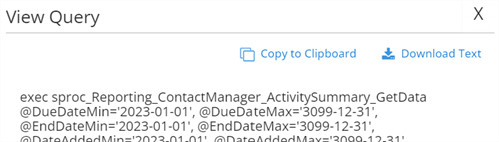
    • Shows the View Query dialog

Example

The example shows the Groups page using the filters available on the left.
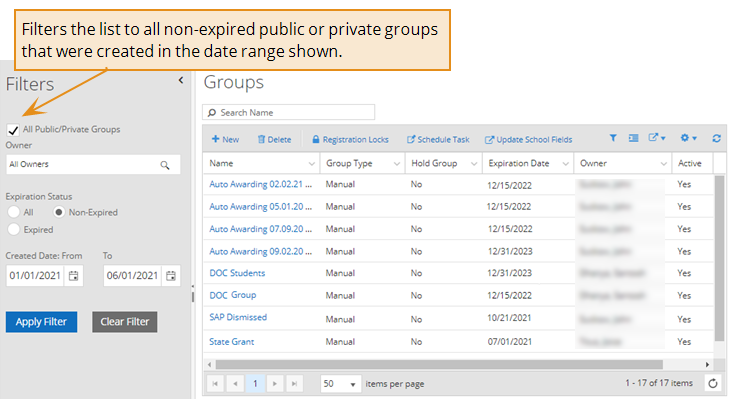
Shows the Groups page using filters.